Home › Health › Trending report
Doctors Measured What Five Minutes of Prayer Did to 180 Anxious Patients. The Scores Kept Dropping for Six Weeks.
A randomized trial in a family-medicine waiting room put spoken prayer head to head with music. Prayer won at every measurement, and the gap was still there at week six. Here is what the authors found, and the one thing patients now keep within reach at night.
For years the advice for the anxious hour has been the same: breathe, count backwards, put on a sleep sound, download another app. And for years, women have watched the worry come back at 1 AM anyway. Sometimes within minutes.
Now a peer-reviewed trial has measured something most of those apps leave out.
The trial
Researchers recruited 180 patients waiting for family-medicine appointments. To qualify for the anxiety arm, a patient needed a score of 10 or higher on the GAD-7, the standard seven-question anxiety scale.1
Then the split. In the authors’ words: “After their appointments, participants received 5 minutes of either Christian PIP (90 individuals) from a trained volunteer prayer practitioner or music (control, 90 individuals).”1
Five minutes. One trained volunteer, praying in person. Against five minutes of music, the very thing most sleep apps sell.
SEE THE CROSS PATIENTS ARE KEEPING WITHIN REACH →What the scores did
“Proximal intercessory prayer vs control group participants reported significantly larger (1 to 2 point) reductions in pain immediately and 2 weeks later, and larger (roughly 2 point) reductions in Likert anxiety immediately and GAD-7 at 2 and 6 weeks.”1
Immediately. At two weeks. At six weeks. The music group got music. The prayer group got a measurable drop that outlasted the session by a month and a half.
Two more lines from the abstract matter for anyone reading this at 1 AM. “Participants reported no adverse events.” And: “Most participants reported wanting future PIP opportunities along with medical visits.”1
It is not the first time. A 2010 trial in the International Journal of Psychiatry in Medicine gave patients six weekly in-person prayer sessions. “At the completion of the trial, participants receiving the prayer intervention showed significant improvement of depression and anxiety, as well as increases of daily spiritual experiences and optimism compared to controls (p < 0.01 in all cases).” “Subjects in the prayer group maintained these significant improvements (p < 0.01 in all cases) for a duration of at least 1 month after the final prayer session.”2 Ninety-five percent of those subjects were women.
BUY ONE, GIFT ONE FREE → SEE THE PROMISE CROSSThe problem the trial did not solve
The trial had a volunteer in the room. You, at 1 AM, do not. What you have within reach is a lit phone, and the Bible is eight feet away on the dresser. In the three seconds before you decide anything, your hand has already chosen.
That is the reach problem. Sleep apps are music. Devotional apps are notifications with a subscription attached. A verse card is eyes open, lamp on, mind back on. None of them are in your ear in the dark.
What patients are keeping within reach
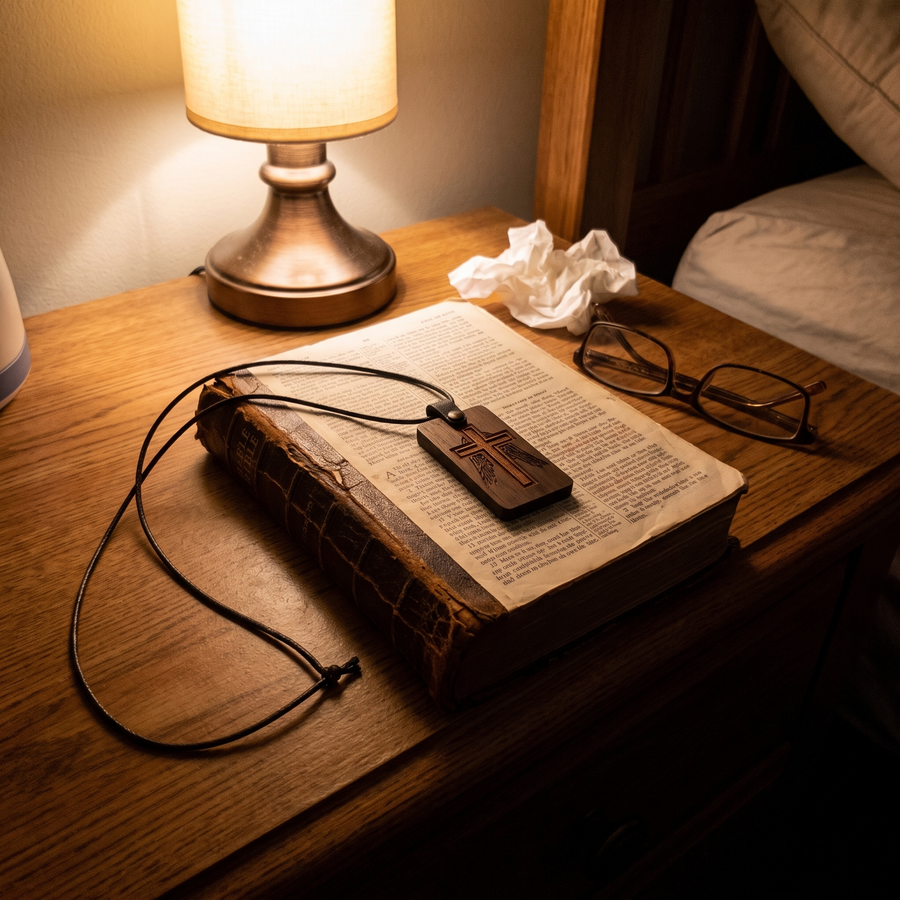
A growing number of praying women have started wearing a small carved wooden cross called The Promise Cross. Hold any phone to it and the day’s verse opens and is read aloud. No app, no account, no battery. The trial tested prayer, not a necklace. Wood does nothing. The cross is what makes sure the prayer happens: the words are spoken into the room, out loud, which is the one thing the phone never gives you.
The wearer reads the promise, prays it back with the name she is carrying, and puts the phone face down. Wood does nothing. God does things. The cross is only the reminder that is already in her hand.
SEE THE PROMISE CROSS →Buy One, Gift One Free · 4.9/5 by 7,000+ believersEvery order ships as a pair: one for you, one for the woman who is awake too. Prayed over before it ships. Rated 4.9/5 by 7,000+ believers.
The Promise Cross: Buy One, Gift One Free
- Tap it and today’s verse opens and is read aloud. Any iPhone from the 7 up, any Android. No app, no account, no battery, nothing to charge.
- Hand-carved acacia, no two grains alike, on a 27.5 inch adjustable cord. Shower-safe, dishes-safe, school-run-safe.
- Buy One, Gift One Free. Every order ships as a pair. One is yours. The other is for the woman who is awake too.
- Printed prayer card in every box. Free tracked shipping.
- Prayed over before it ships. Rated 4.9/5 by 7,000+ believers.
Two crosses for $64.99. About $32 each. Less than one month of the subscriptions it replaces.
GET THE PROMISE CROSS → BUY ONE, GIFT ONE FREEBuy One, Gift One Free · Free tracked shipping · 60-Day Promise1 Prayer for Pain and Anxiety in a Primary Care Setting: A Randomized Controlled Trial. Annals of Family Medicine, 2026. PubMed 42191375.
2 A randomized trial of the effect of prayer on depression and anxiety. International Journal of Psychiatry in Medicine, 2010. PubMed 20391859.
Reader comments